Building a rate book you can actually defend
A rate book is not a price list somebody sold you. It is what YOUR crew, on YOUR jobs, actually costs — and the only place it can come from is the work you have already won.
Why a published price list is the wrong starting point
National and regional cost data is built from averages across companies with different crews, different overhead, different suppliers and different local markets. It is useful as a sanity check and dangerous as a source, because the one thing it cannot tell you is what YOU cost.
The second problem is defensibility. When a client asks where a number came from, "the regional average" is a worse answer than "that is my rate, and here is the quantity it is multiplied by."
The shape of a rate
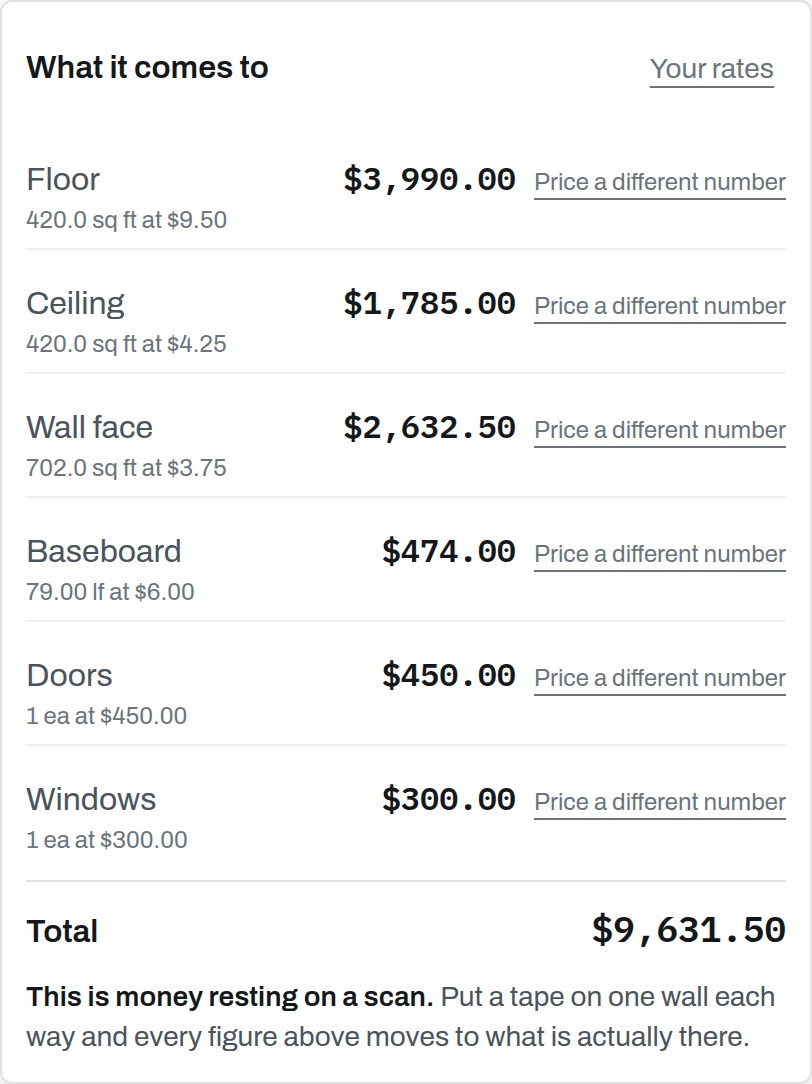
One rate is a unit, a price, and the trades it covers. That is all:
| Item | Unit | What it has to cover |
|---|---|---|
| Wall face | sq ft | Board, screws, mud, tape, labour to finish |
| Ceiling | sq ft | Same, plus the difficulty of working overhead |
| Floor | sq ft | Material, underlay, labour, transitions |
| Baseboard | lf | Stock, fasteners, mitres, caulk, labour |
| Doors | ea | Slab, jamb, casing, hardware, hanging |
| Windows | ea | Trim and finish, not the unit itself unless you say so |
Whether a rate is labour-only, labour-and-material, or material-only is a decision you make once and then never vary, because a book with both kinds in it and no label is a book that will one day quote a floor with no material in it.
Building it from jobs you have already done
Take a job you finished and were happy with. You know what you charged. Divide it by the quantity you actually did, and you have a rate — a real one, from your own crew, at your own overhead.
This is why Trueline can suggest rates without inventing any: it works them out from the jobs you marked won, takes the median rather than the mean, and never changes your book unless you tap the suggestion.
The line with no rate against it
Every takeoff eventually produces a line you have no rate for. There are exactly two honest responses, and pricing it at zero is not one of them.
- Put a rate against it, now, even a rough one you intend to revisit.
- Name it on the proposal as excluded, so the client knows it is not in the number.
A quote that adds up perfectly and is silently missing a floor is the worst document in this trade. Trueline will not price an item at zero for this reason — an item with no rate is listed by name instead, on the screen and on the proposal.
Questions people ask
- Should I use national construction cost data for pricing?
- As a sanity check, not as a source. It averages across companies with different crews, overhead and suppliers, so it cannot tell you what you cost — and "the regional average" is a much weaker answer to a client than "that is my rate".
- How do I work out my unit rates?
- Take jobs you finished and were happy with, divide what you charged by what you actually did, and use the median across several jobs rather than the average so one unusual job does not move your book.
- Should rates include labour and material together?
- Either is fine as long as every rate in the book is the same kind and it is written down which. Mixing them without a label is how a floor gets quoted with no material in it.
- What do I do about an item I have no rate for?
- Price it or exclude it — never let it come through at zero. A quote that adds up perfectly and is short by a floor is worse than one with a gap you can see.
Where this fits with Trueline
Trueline is an iPhone app that measures a room, takes it off, prices it from your own rate book and turns it into a proposal — with every length carrying whether it was scanned, drawn or measured, right onto the document a client reads. See how it works, or take the free templates and use them with whatever you already have.