What a construction estimate has to include
Most estimate disputes are not about the price. They are about something the estimate did not say — and every one of those omissions is on this list.
The eleven things
An estimate is a document somebody will read again in three months, angry. Write it for that reading rather than for the one where they are pleased with you.
Who you are
Business name, address, phone, licence number and insurance. A licence number on an estimate is not decoration — in most states a homeowner can check it in thirty seconds, and the ones who do are the ones who pay on time.
Who it is for, and where the work is
The client’s name and the address of the work, which are frequently not the same address. Every later document — change orders, invoices, lien notices — hangs off this line.
A date, and how long the price holds
Material prices move. An estimate with no expiry is an open offer, and you will be held to it. Thirty days is common; whatever you choose, print it.
The scope, in sentences
What is being done, in the order it will be done, in language a homeowner reads without a glossary. This is the section that decides arguments.
The quantities
How much of each thing. Not because a client checks them, but because a client who can see 416 sq ft of wall face understands where the number came from — and because you will need them when the scope changes.
The price, broken out enough to be defensible
Line by line, or by trade, or by phase. One number with nothing behind it reads as a guess even when it is not.
What is NOT included
The most valuable paragraph in the document. Permits, disposal, painting, anything behind a wall nobody has opened. Every exclusion you write is an argument you have already won.
Allowances, if any
Where the client picks the material later, say what you have allowed and what happens when they pick something dearer. An allowance with no number in it is a change order waiting to happen.
Payment terms
Deposit, progress payments and what triggers each one. "On completion" is not a trigger; "on completion of rough-in" is.
How change orders work
One sentence: work outside this scope is quoted and signed before it starts. Then hold to it, every time, including the small ones.
Somewhere to sign
An estimate nobody signed is a conversation. A signed one is a scope, and the difference shows up the first time somebody says "I thought that was included."
Estimate, quote, bid, proposal
These words are used loosely and it matters which one you have handed over.
| What it is | What it means to a client | Risk to you |
|---|---|---|
| Estimate | A considered guess that may move | Low — if it says so on the paper |
| Quote | A price you will honour | High — you own the overrun |
| Bid | A price offered in competition | High, and usually under pressure |
| Proposal | Scope and price, offered for signature | Depends entirely on the scope section |
Whichever you write, the word at the top should match the terms underneath it. An "estimate" with a fixed price and a signature line is a quote wearing a hat.
Where the quantities come from
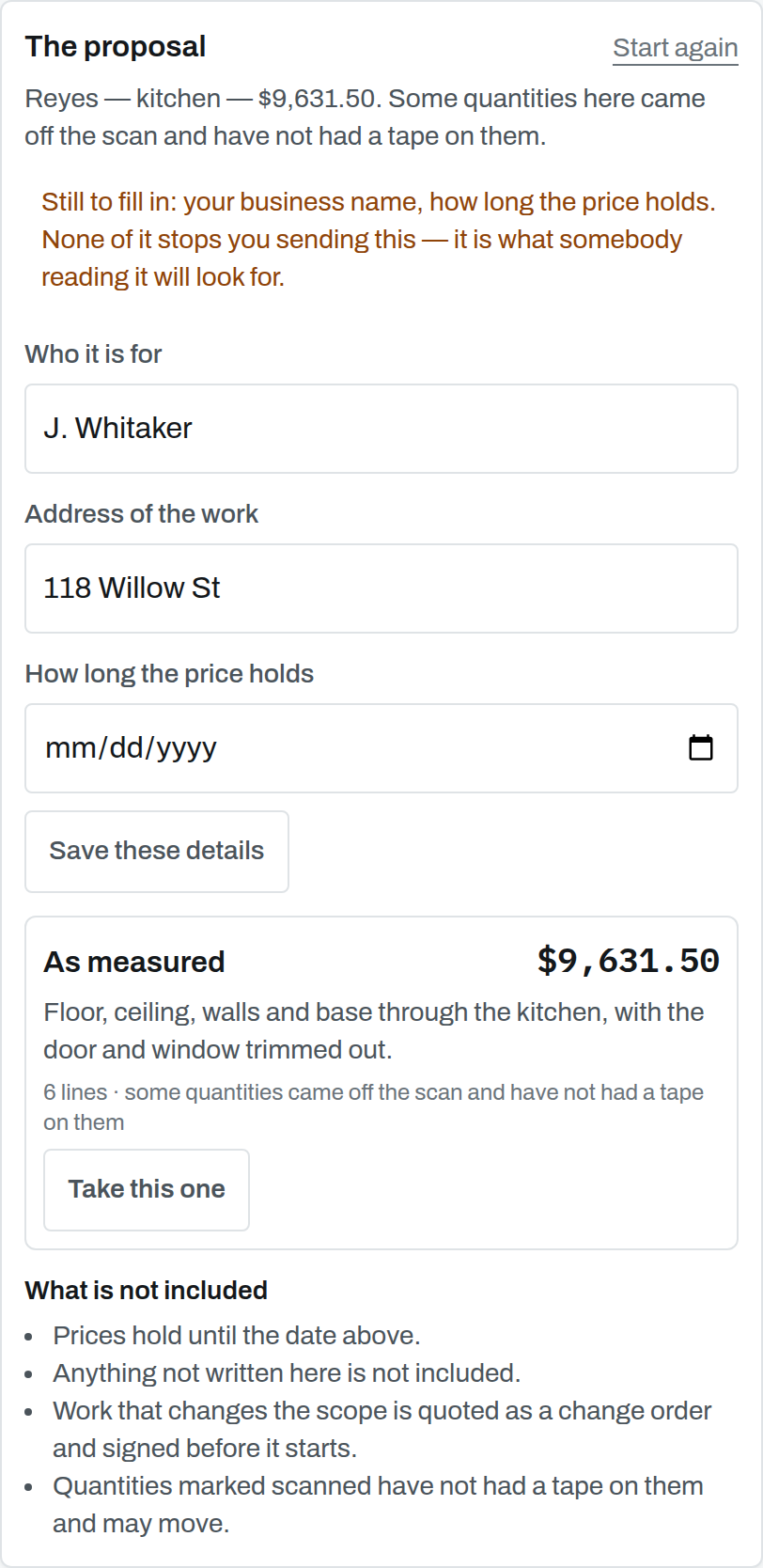
Everything above assumes you have quantities to print. On a remodel that means measuring the room, and the honest problem with measuring is that the numbers you took standing up in a half-demolished kitchen become numbers on a legal document later, with nothing on the page saying which is which.
That is the specific thing Trueline was built to fix: a length carries how it was arrived at — scanned, drawn, or measured with a tape — right through onto the estimate, so the document tells the client what it is standing on.
Free download: Blank construction estimate — a blank PDF to print, generated by the same code that produces the app’s own documents. All the templates.
Questions people ask
- Is a contractor’s estimate legally binding?
- It depends on what the document says and on your state. A document headed "estimate" that states the price may change is generally treated differently from a fixed quote that has been signed. The safest position is that the words on the page decide it, so write them deliberately rather than reaching for a template.
- How detailed should a construction estimate be?
- Detailed enough that a client can see where the number came from and detailed enough that you can tell, later, whether something was in scope. In practice that means quantities and a real exclusions list, not a per-square-foot number with nothing behind it.
- Should I charge for an estimate?
- A walk-through and a rough number is usually free. A measured takeoff on a large remodel is a day of work, and plenty of contractors charge for it and credit it against the job if they win it. What matters is saying which one you are offering before you start.
- What should never go in an estimate?
- A quantity nobody measured, presented as though somebody had. That is the failure that turns into a dispute you cannot win, because you cannot show where the number came from.
Where this fits with Trueline
Trueline is an iPhone app that measures a room, takes it off, prices it from your own rate book and turns it into a proposal — with every length carrying whether it was scanned, drawn or measured, right onto the document a client reads. See how it works, or take the free templates and use them with whatever you already have.