How to write a remodeling proposal a homeowner will sign
An estimate answers "how much". A proposal answers "what am I agreeing to" — and that is the question a homeowner is actually stuck on.
Write the scope before the price
The price is the part everybody drafts first and the part nobody argues about. Arguments are about scope, months later, when the words on the page are all anybody has. Write those words as though you will not be in the room to explain them.
Three sentences, in the order the work happens, in a homeowner’s vocabulary. Not "demo, R&R GWB, finish L4" — "take the old floor and the base out, board and finish the walls, then lay the new floor and put the base back."
Offer two options, not one price
A single number is a yes-or-no question, and a homeowner who is uncertain answers those with "let me think about it". Two options change the question from whether to hire you into which one to pick.
| Option | What it is | Why it works |
|---|---|---|
| As measured | Exactly the scope you walked | The honest baseline |
| With the extra | One meaningful addition — the closet, the lighting, the second coat | Gives a yes somewhere to land that is not "no" |
Two is the number. Three starts to look like a menu and pushes people back into deciding rather than choosing.
The exclusions paragraph is the most valuable one
Everything you do not say is included is a conversation you will have later, from a weaker position. Write the list plainly:
- Permits and inspection fees, if they are not yours.
- Disposal and dumpster, if separate.
- Anything behind a wall nobody has opened yet.
- Painting, if the scope stops at finished board.
- Moving furniture, appliances and the contents of the room.
- Anything the quantities were scanned rather than measured — say it, and say when it will be measured.
The last one is unusual and it is worth doing. A proposal that says "these quantities came off a scan and will be confirmed with a tape before work starts" reads as careful rather than uncertain, and it protects you when a number moves.
Signing it properly
An electronic signature is a signature. Under the federal ESIGN Act and the state UETAs, a record is not invalid merely because it is electronic, and no signing service is required — what decides a dispute is the quality of the record you kept.
A record worth having says who signed, when, on what device, the exact wording they agreed to, that they consented to sign electronically, and a hash of the document as it stood at that moment. Anything less is a picture of a name.
That is what Trueline records, and the signed scope then becomes the thing the job is measured against — never edited, with anything that changes becoming a change order that is itself signed before work starts.
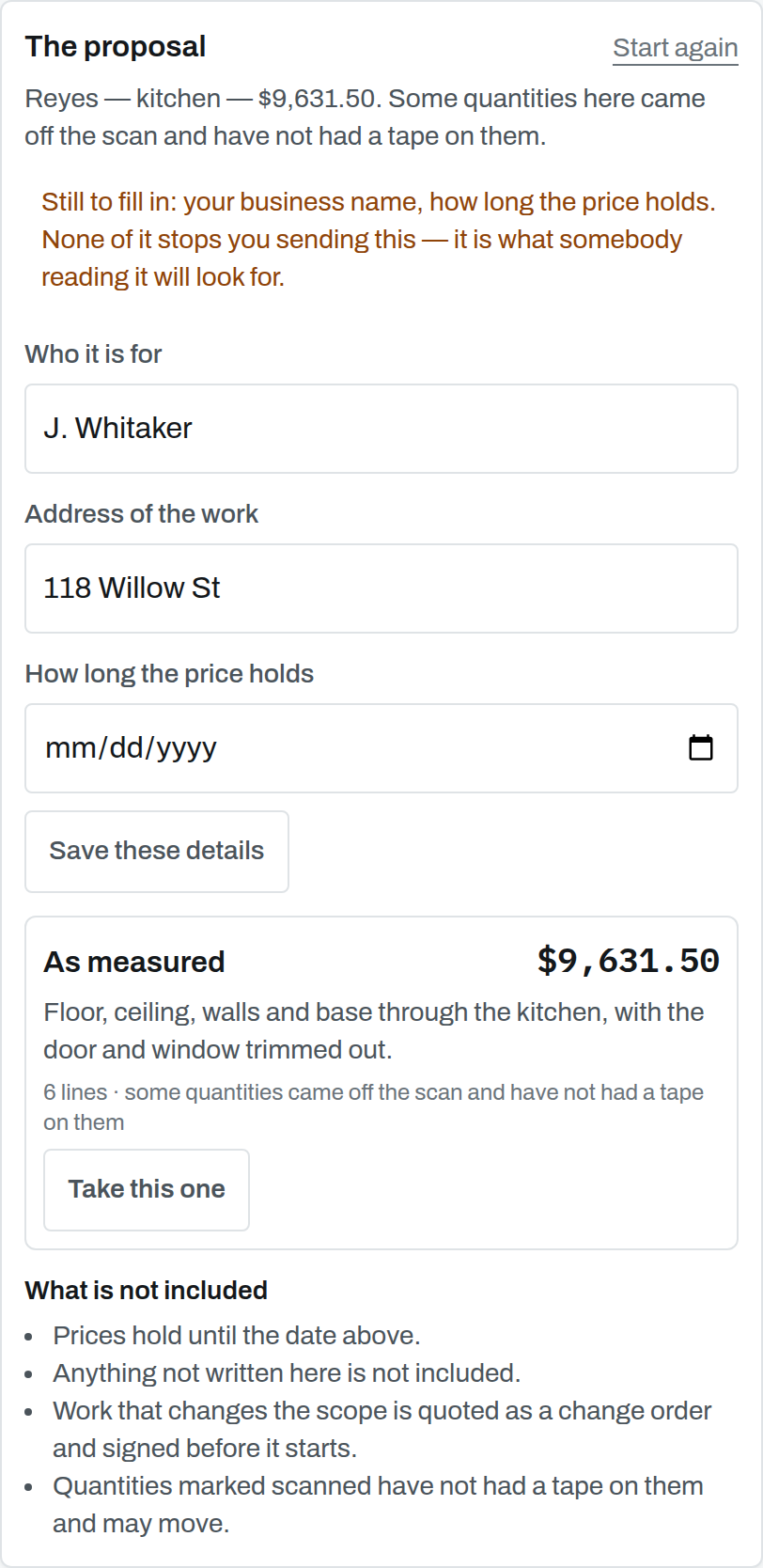
Free download: Remodeling proposal, two options — a blank PDF to print, generated by the same code that produces the app’s own documents. All the templates.
Questions people ask
- What is the difference between an estimate and a proposal?
- An estimate is a price. A proposal is a scope offered for signature, with a price attached and an exclusions list. The proposal is the document that decides a dispute, because it says what was agreed rather than only what it cost.
- Are electronic signatures legal for construction contracts?
- In the United States, the ESIGN Act and state UETA laws mean a contract is not invalid simply because it was signed electronically, and no third-party service is required. What matters in a dispute is the record: who signed, when, what exact wording they agreed to, and proof the document has not changed since.
- How many options should a proposal have?
- Two. One is a yes-or-no question and gets "let me think about it"; three or more turns it into a menu and delays the decision.
- Should a proposal show quantities?
- Yes. A homeowner who can see 416 square feet of wall face understands where the number came from, and you will need those quantities the moment the scope changes.
Where this fits with Trueline
Trueline is an iPhone app that measures a room, takes it off, prices it from your own rate book and turns it into a proposal — with every length carrying whether it was scanned, drawn or measured, right onto the document a client reads. See how it works, or take the free templates and use them with whatever you already have.