What an adjuster is actually looking for in your file
An adjuster is not looking for reasons to deny. They are looking for enough to approve without being second-guessed — and a file that supplies it moves fast.
The five questions, in order
What was the source?
Coverage often turns on this before anything else. A photograph of the failed component, with enough context to show what it is attached to.
When did it happen, and when was it found?
Two dates, separately. The gap affects category and it affects what could reasonably have been prevented.
What is actually damaged?
Which materials, which rooms, how far. With photographs taken before anything moved, and with measurements rather than adjectives.
How do you know it was wet?
Moisture readings against a dry standard, at identified points, over time.
What are you proposing, and why that?
Scope tied to the damage, with the reasoning visible — especially where the scope exceeds the visible damage, as a flood cut always does.
What slows a file down
- Photographs with no wide shot, so nothing can be located.
- A single "area" figure with no indication whether it is floor, wall face or ceiling.
- Moisture readings with no dry standard, or with the scale changing partway through.
- A scope that exceeds the documented damage with no explanation of why.
- Quantities that appear on the estimate but nowhere in the documentation.
- Twenty-eight attachments and no document that puts them in order.
Every one of those is a request for information, and every request for information is a week. The cost of thorough documentation is an hour on site; the cost of thin documentation is measured in weeks of float.
One document, in the right order
The thing that moves a claim is a single file an adjuster can read start to finish: the loss narrative, the property and the dates, the room with its measurements, each damage with its area and its photographs, the moisture log, and the scope. In that order, because that is the order the questions come in.
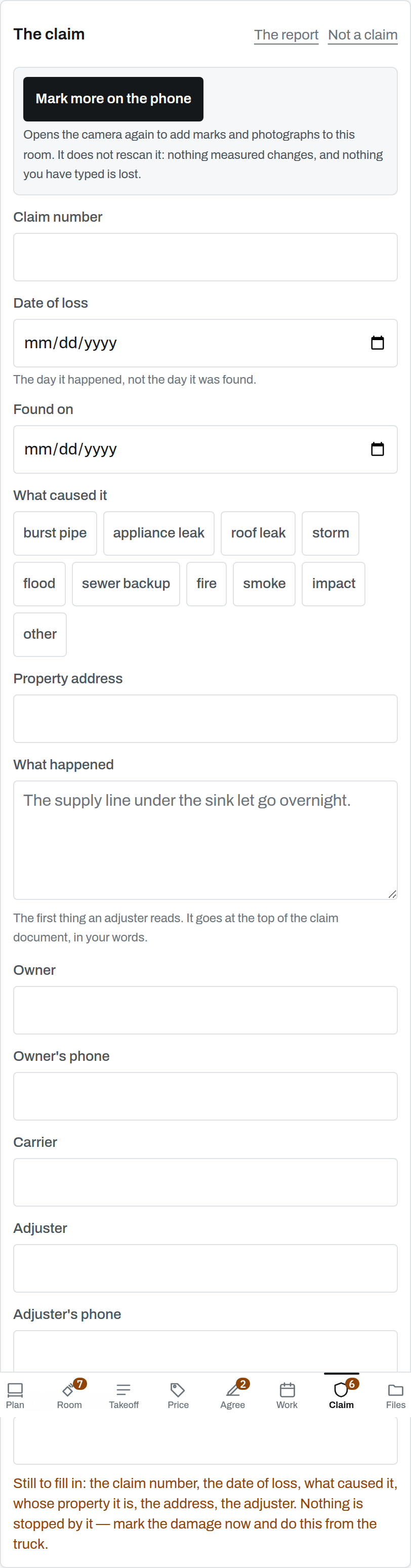
That is exactly what Trueline’s claim document is — assembled from the measurements and marks you took on site, with each figure showing where it came from and each photograph attached to the damage it belongs to rather than to an email.
The difference between evidence and assertion
Almost every weak claim file is full of assertions. "The wall was wet." "Extensive damage." "Full replacement required." Every one of those is a statement the reader has to take on trust, from somebody with a financial interest in it.
| Assertion | The same thing as evidence |
|---|---|
| “The wall was wet.” | “North wall read 18% on 14 March against a dry standard of 9% on the same wall type.” |
| “Extensive damage.” | “Affected 9 ft along the north wall to 18 in, and 6 ft along the east wall to 14 in.” |
| “Full replacement required.” | “Cut at 4 ft across both runs; water observed to 26 in and outlets at 14 in.” |
| “Dried on 22 March.” | “Readings fell from 18% to 9% between 14 and 22 March at the same four points.” |
The right-hand column is not more work. It is the same information written down at the time instead of summarised afterwards.
Supplements, and how to avoid needing one
Most supplements exist because something was found later that was not documented earlier — wet insulation behind board that came off on day three, a second room that turned out to be affected, a subfloor nobody read.
The two habits that reduce them are boring and effective: read more points than you think you need on the first visit, and photograph everything at the moment it becomes visible. A photograph of wet insulation taken as the board came off is worth more than any amount of explanation later.
Free download: Water damage and moisture log — a blank PDF to print, generated by the same code that produces the app’s own documents. All the templates.
Questions people ask
- What makes an insurance adjuster question an estimate?
- Numbers with nothing behind them. A scope that exceeds the documented damage with no reason given, an area figure that does not say whether it is floor or wall, or quantities on the estimate that appear nowhere in the documentation.
- How much documentation is too much?
- There is no such thing as too much evidence, but there is very much such a thing as too little order. Twenty-eight attachments with no document organising them is worse than eight photographs inside one file that reads start to finish.
- Does better documentation actually get claims paid faster?
- Every gap is a request for information and every request for information is delay. A file that answers the five standard questions without being asked removes the reasons to come back to you.
- What is the difference between evidence and assertion in a claim?
- An assertion is “the wall was wet”. Evidence is “north wall read 18% on 14 March against a dry standard of 9% on the same wall type”. Same information, written down at the time rather than summarised afterwards.
- How do I avoid having to file a supplement?
- Read more points than you think you need on the first visit, and photograph anything the moment it becomes visible — wet insulation as the board comes off, a subfloor as it is exposed. Most supplements are things found later that were not documented earlier.
Where this fits with Trueline
Trueline is an iPhone app that measures a room, takes it off, prices it from your own rate book and turns it into a proposal — with every length carrying whether it was scanned, drawn or measured, right onto the document a client reads. See how it works, or take the free templates and use them with whatever you already have.