What a contractor’s estimate should include
You are not really being asked to approve a price. You are being asked to agree a scope — and almost every dispute afterwards is about something the estimate did not say.
The checklist
- Who they are — business name, address, phone, licence number and insurance. In most states you can check a licence online in about thirty seconds. Do it.
- Your name and the address of the work — these are sometimes different, and every later document hangs off this line.
- A date, and how long the price holds. Materials move. An estimate with no expiry is unusual and worth asking about.
- The scope, in sentences you understand. If you cannot read it, do not sign it.
- Quantities. How much of each thing. This is what lets you compare two quotes at all.
- The price, broken out. One number with nothing behind it tells you nothing about whether it is reasonable.
- What is NOT included. The most valuable paragraph on the page.
- Allowances — where you pick the material later, what has been allowed, and what happens if you pick something dearer.
- Payment terms — deposit, stages, and what triggers each one.
- How changes get handled — and the right answer is: quoted and signed before the work starts.
- Somewhere to sign.
Why the exclusions matter more than the price
A shorter quote is not a better quote. Very often it is the same job with fewer things written down — and everything not written down becomes a conversation later, while your kitchen is in pieces.
When you compare two estimates, read the exclusions first. The one that says "permits, disposal and anything found behind the wall are not included" is being straight with you. The one that says nothing has the same exclusions; it just has not told you yet.
The lowest number frequently belongs to the least complete document. That is not always dishonesty — it is often just less careful — but it is the same outcome for you.
Quantities are how you compare two quotes
Two estimates for "the kitchen" cannot be compared. Two estimates that both say 416 square feet of wall face, 168 of ceiling, 52 feet of base, one door and one window can be — and if their quantities differ, one of them has measured something the other has not, which is worth asking about before you look at either price.
A fair question to ask
Ask whether the quantities were measured or estimated. It is a completely normal question, it is not rude, and the answer tells you a lot about how the job will be run. A contractor who says "those came off a scan, I will confirm them with a tape before we start" is being more careful than one who says "they are accurate".
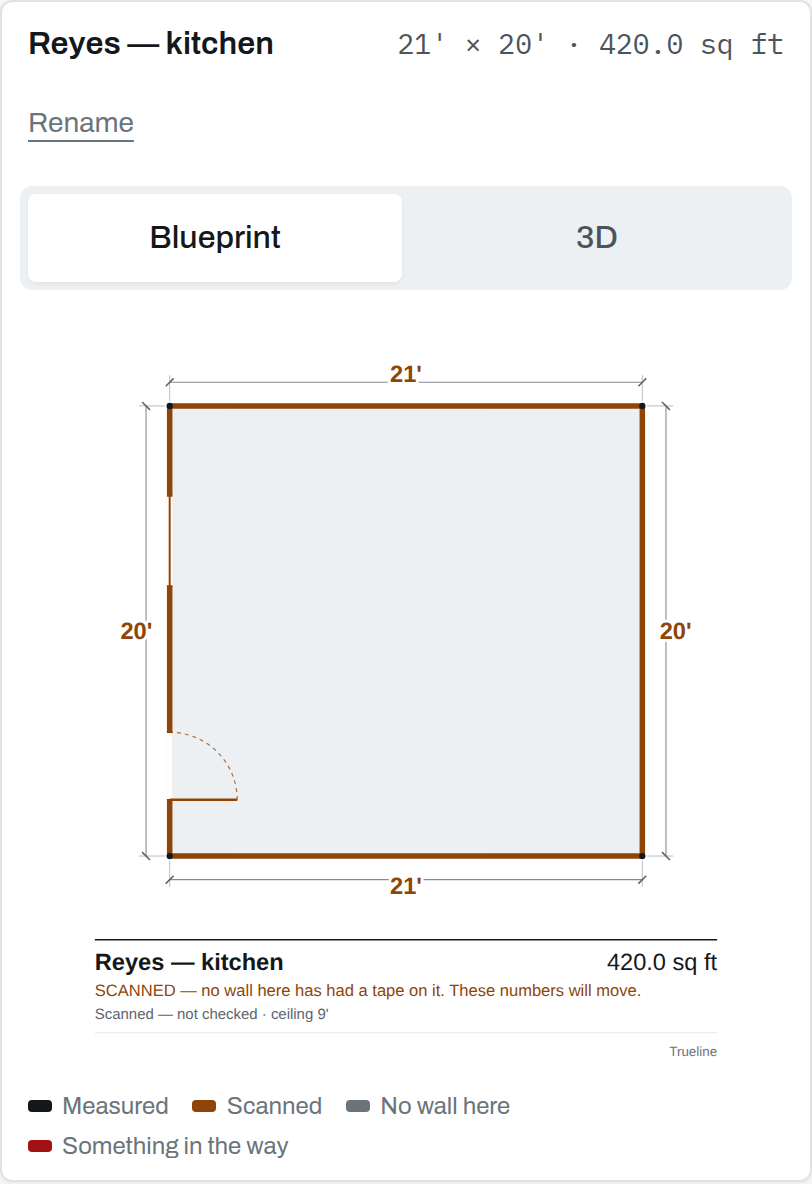
Some tools now put this on the document itself. Trueline prints the word SCANNED across a drawing until somebody has actually put a tape on the walls — which is unusual, and worth knowing exists so you can ask for it.
Free download: Blank construction estimate — a blank PDF to print, generated by the same code that produces the app’s own documents. All the templates.
Questions people ask
- Should a contractor’s estimate be itemised?
- Detailed enough that you can see where the number came from — quantities and a real exclusions list. A single figure with nothing behind it gives you no way to compare it to anything.
- Is a contractor estimate legally binding?
- It depends on what the document says and on your state. A document headed "estimate" that says the price may change is treated differently from a signed fixed quote. Read the words at the top and the payment terms at the bottom.
- What is the most important part of an estimate?
- The exclusions. Everything not written down becomes a conversation later, from a weaker position, while your house is in pieces.
- Should I pay a deposit?
- A deposit is normal, especially where material has to be ordered. What matters is that the amount and what triggers each later payment are written down, and that the stages are tied to work rather than to dates.
Where this fits with Trueline
Trueline is an iPhone app that measures a room, takes it off, prices it from your own rate book and turns it into a proposal — with every length carrying whether it was scanned, drawn or measured, right onto the document a client reads. See how it works, or take the free templates and use them with whatever you already have.